
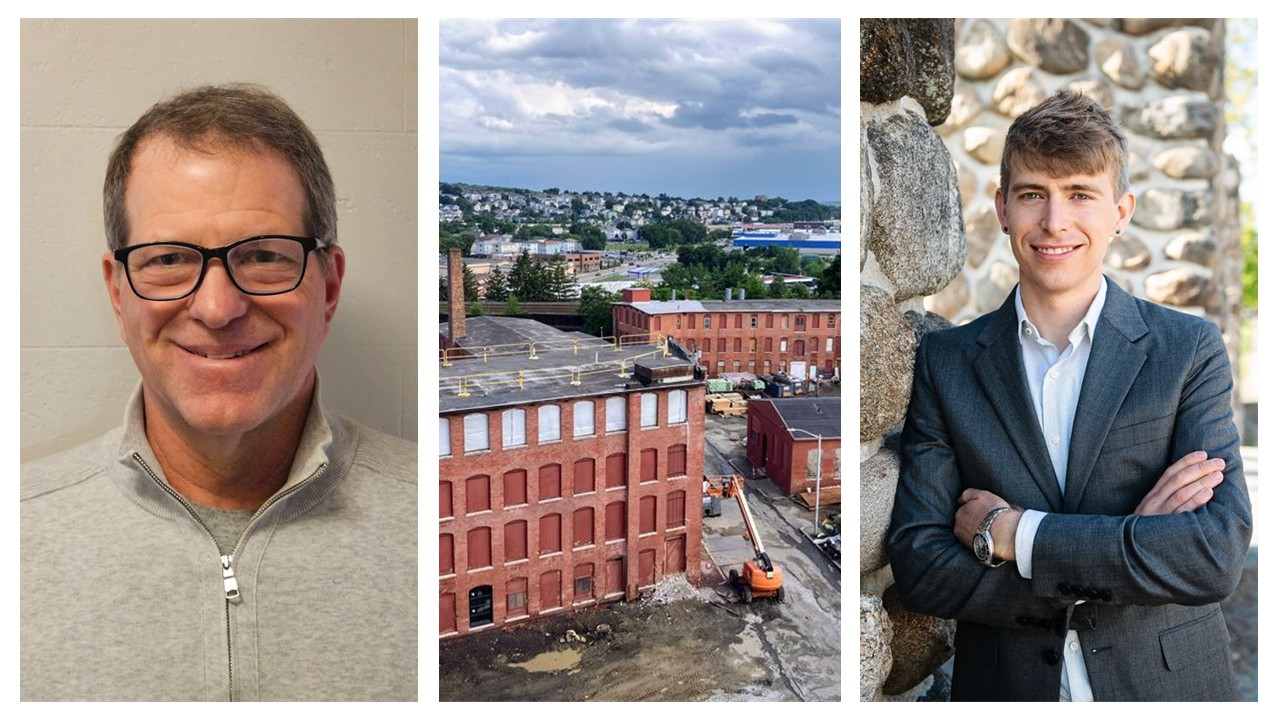

The redevelopment of Worcester’s historic Lagrange Mills into affordable housing is much more than a great story about transforming former industrial buildings into new homes. The project demonstrates how collaboration, creative financing and patient capital can help communities overcome the challenges of historic preservation, environmental remediation and adaptive reuse while creating lasting benefits for the surrounding area.
In the latest installment of PCI’s Three Questions With series, Jon Rudzinski of Reed-Larkin Development LLC and Taylor Beardon of Civico come together to discuss the partnerships that made the project possible, the important role that PCI’s flexible financing played in navigating a lengthy and complex development process, and how the Lagrange Mill development is addressing Worcester’s housing needs while preserving its industrial heritage and supporting the neighborhood’s future.
1. Projects like Lagrange require multiple sources of financing and a range of partners. What did the partnerships between project stakeholders make possible that wouldn't have been possible working independently?
Jon Rudzinski: The redevelopment of Lagrange Lofts is a genuine partnership across the public, quasi-public, and private sectors. We started with a patient seller who held the property and operated his family’s multi-generational manufacturing business while we assembled the capital stack. We worked together to carefully time the wind-down of his business to coincide with the start of construction. The structures had become uncompetitive as manufacturing space but were still an important part of the urban fabric in a well-located neighborhood close to downtown. PCI supported us during pre-development and with a bridge loan when the closing was unexpectedly delayed.
The City of Worcester did tremendous work through its Affordable Housing Trust and as the conduit EPA environmental clean-up funds. Our government partners provided tax credits and the soft subsidy that is both customary and essential to deals like this, while the Secretary of the Commonwealth and National Park Service provided tax credits to support the historic rehabilitation.
We also worked closely with the site’s sole remaining commercial tenant to help them secure long-term ownership of their urban farm, which transitioned from a tenant relationship into an ownership stake for a nonprofit that had a long history in the neighborhood. Although affordable housing production is main theme, the project is also an environmental remediation, historic preservation, and adaptive reuse effort.
2. What role did flexible, mission-oriented capital play in helping move the project forward, particularly given the complexity of financing a historic adaptive-reuse project?
Taylor Bearden: Flexible, mission-oriented capital was indispensable, from pre-development to closing. We spent more than five years in predevelopment before we broke ground, which was made possible by PCI’s pre-development capital that stayed patient through that period. PCI was also the last-minute source that helped us bridge to closing when we experienced unexpected delays associated with environmental contamination. PCI and the team stay close to the work, know their partners, and understand the unique risk profile of a project like this, including the environmental exposure that comes with redeveloping a former industrial site. Importantly, PCI also understands the nuances of the tax-credit financing that, ultimately, takes out the pre-development financing. Their experience with this kind of complexity made it possible for us to navigate the uncertainty through the protracted pre-development period and into our tax credit closing.
3. Worcester has experienced significant growth and investment in recent years. How do you see Lagrange Mill contributing to the city's next chapter, particularly in creating housing while preserving pieces of its industrial history?
Taylor Bearden: The composition of the historic mill buildings on the street is akin to an urban campus. Although the four buildings comprising Lagrange Mill are the focal point of the project, the impact spans the better part of two city blocks. One of the outcomes which we are proudest of is that the project’s sole commercial tenant, the Regional Environmental Council (REC), was able to secure ownership of the urban farm it had used for more than two decades. That acquisition gave REC a permanent home for work that includes providing paid jobs for Worcester teens to grow food and develop leadership skills on an urban farm, bringing hands-on garden education to thousands of local students in schools across the city, and operating farmers’ markets and mobile markets that bring fresh, healthy, locally grown food to more than 5,000 residents each year. Through its 50th-anniversary capital campaign, REC is now transforming the farm and surrounding properties into a permanent campus with a new greenhouse and warehouse, along with expanded classroom, office, and community spaces.
The project would not have happened under any other conditions. The adaptive reuse hurdles and post-industrial contamination were too substantial to have been undertaken without this particular mix of subsidy and mission-driven partners.


