
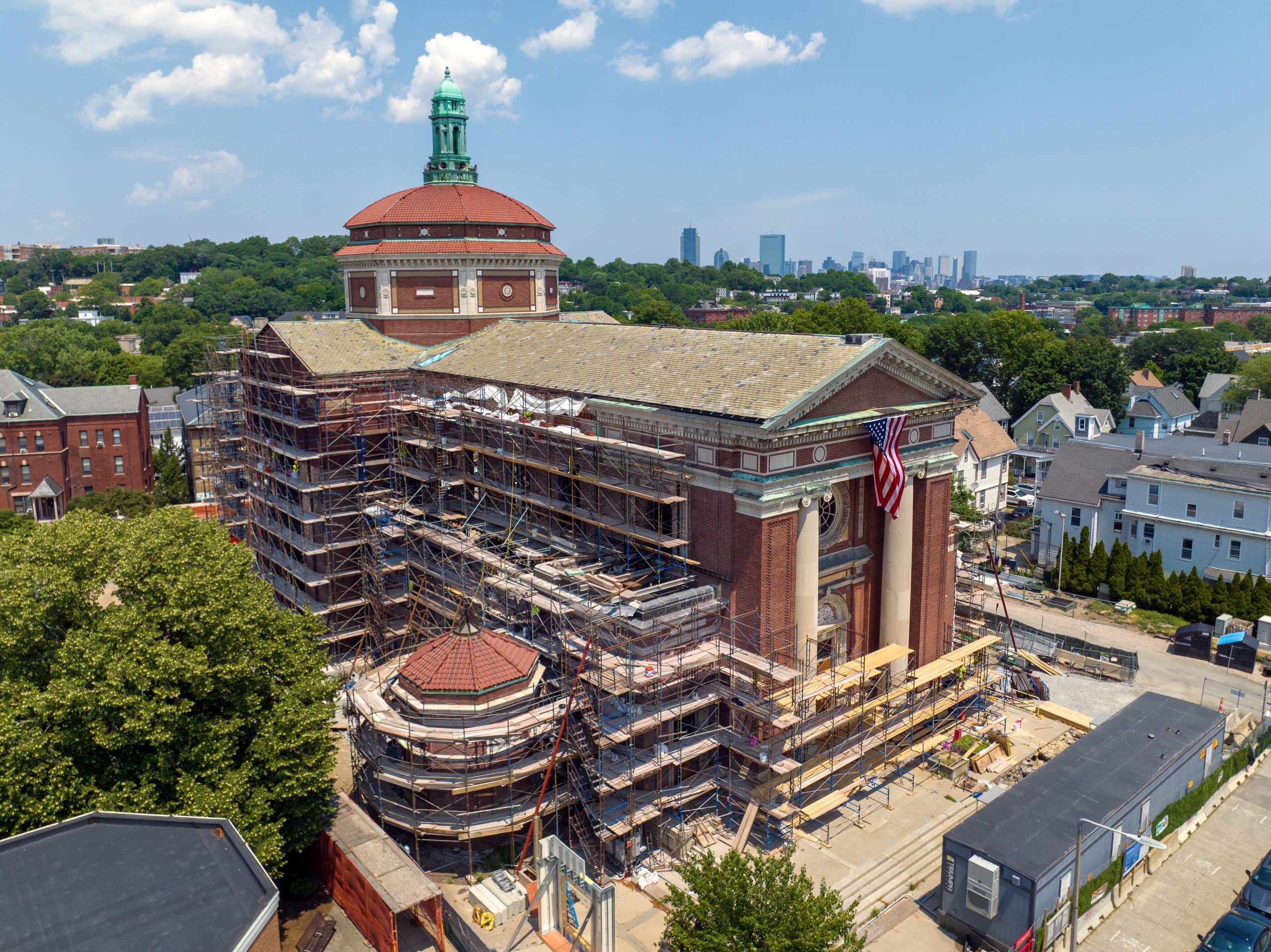

When construction began on the final phase of the Blessed Sacrament redevelopment in Jamaica Plain, it was a milestone more than 20 years in the making. What might look like the beginning of another construction project is actually the culmination of a much longer story. One shaped by a community vision, changing economic conditions, evolving plans and a group of partners willing to stay committed when the path forward was anything but certain.
The Blessed Sacrament campus has been transformed over the past two decades through a series of developments that have created permanent supportive housing, affordable rental and for-sale housing, market-rate housing, retail space, nonprofit offices and, ultimately, additional opportunities for affordable homeownership. Together, these series of projects represent what community development can accomplish when a long-term vision is supported by strong partnerships and capital that is willing to be patient. The story also demonstrates an important truth about community development: it rarely happens on a straight line.
The Scope of Redevelopment
The Blessed Sacrament redevelopment began when the Jamaica Plain Neighborhood Development Corporation (JPNDC) and New Atlantic Development Corporation (NADC) partnered togetherto transform the campus into a mixed use development that would respond to the needs of the surrounding Jamaica Plain neighborhood.
Over time, six different projects were developed across the campus by the original partners and several new partners. One portion became 27 permanent supportive housing units developed by Pine Street Inn. Another created ground-floor retail with 36 affordable rental apartments above it. Other parcels included market-rate housing, 16 affordable townhomes and nonprofit administrative space for the Hyde Square Task Force. The final phase, the redevelopment of Blessed Sacrament Church by Pennrose and Hyde Square Task Force, will add another important dimension, homeownership opportunities and cultural programming
Taken together, the projects demonstrate that community development does not have to mean choosing between deeply affordable housing, market-rate housing, commercial space, nonprofit uses or homeownership. A thoughtfully planned redevelopment can create opportunities for all of them. But getting here took far longer than anyone anticipated.
Development Isn’t a Straight Line
The original acquisition financing was structured with the expectation that the various parcels would be developed and sold over roughly four years. But the 2008 financial crisis fundamentally changed the economics of the entire project. The market for homeownership dramatically shifted. The tax-credit market changed. Financing conditions became more difficult. Projects that once appeared viable had to be paused, modified or reconsidered.
The original vision of the project had to evolve, but the underlying mission did not, which is an important distinction. Successful community development is not necessarily about executing an original plan exactly as it was conceived. It is about preserving the purpose of that plan while being willing to change how you get there.
That ability to adapt is one reason patient capital matters so much in community development. Complex, community-rooted projects rarely move in a straight line. The projects that succeed are often those built to bend without breaking.
Why Patient Capital Matters
PCI's role in Blessed Sacrament is a particularly useful illustration of what patient capital can mean in practice. PCI participated alongside BlueHub Capital and LISC in the original acquisition financing for the entire campus. BlueHub served as the lead lender, with PCI providing roughly $3.5 million of the approximately $8.2 million acquisition loan. The financing was structured so that portions of the loan would be repaid as individual parcels were developed and sold. But when the development timeline extended beyond the original four-year projection, the lenders had to wait.
The organizations involved were community-based developers, not large national for-profit companies with substantial reserves. If a project could not be sold, there was no easy way to repay the associated debt. A foreclosure would have meant not only a financial loss for the lenders, but a significant setback for the neighborhood.
That is precisely where the value of patient, mission-driven lending becomes apparent. A traditional lender is not necessarily wrong to foreclose on a nonperforming loan. Banks operate under regulatory and financial constraints that often require them to move troubled assets off their books. But community development sometimes requires a different kind of capital that can remain engaged long enough for a viable project to weather an economic cycle.
PCI was ultimately repaid on its original acquisition financing as the individual parcels were developed. Years later, the organization returned to participate in pre-development financing for the final church phase.
In that sense, PCI's involvement bookends the Blessed Sacrament story: providing capital at the beginning of the redevelopment and returning to help advance its final chapter. This represents institutional belief in a community-rooted vision despite changing markets, shifting circumstances and an evolving timeline that extended far beyond the original expectations.
Patient capital is not passive capital. It is an active decision to remain engaged when economic conditions make it easier to walk away.
Why This Story Matters Today
The lessons of the Blessed Sacrament project are particularly relevant in today's uncertain market environment. Higher interest rates, shifting prices and broader economic risks have created significant challenges for developers and community organizations. Many ambitious projects are being delayed or reconsidered, as economic conditions have become more difficult.
Community-rooted projects need financing that recognizes the realities of development rather than forcing every project into a rigid timeline. Sometimes that means waiting. Sometimes it means restructuring a plan. Sometimes it means finding a different financing mechanism, bringing in new partners or changing the intended use of a property. What matters is having partners who can help make those adjustments without losing sight of the ultimate objective.
That is the role PCI seeks to play across Massachusetts: providing catalytic capital that can be patient when needed, to help community-rooted organizations pursue ambitious visions and navigate the inevitable challenges that arise along the way.
More Than One Project
The launch of the final phase of the Blessed Sacrament initiative is a milestone worth celebrating. But its greatest significance may be what the project teaches about how community development actually happens. It occurs over years, not months. It evolves as neighborhoods and markets change. It depends on partnerships that can withstand setbacks. And it requires capital aligned with the communities and projects it is intended to serve.
That is the power of patient capital: not simply financing a project but helping create the conditions for a community's long-term vision to become reality.
For PCI, that is the broader lesson of Blessed Sacrament, and a central part of why it exists. When mission-driven capital, strong partnerships and community leadership remain aligned over the long term, neighborhoods can be transformed in ways that last for generations.


